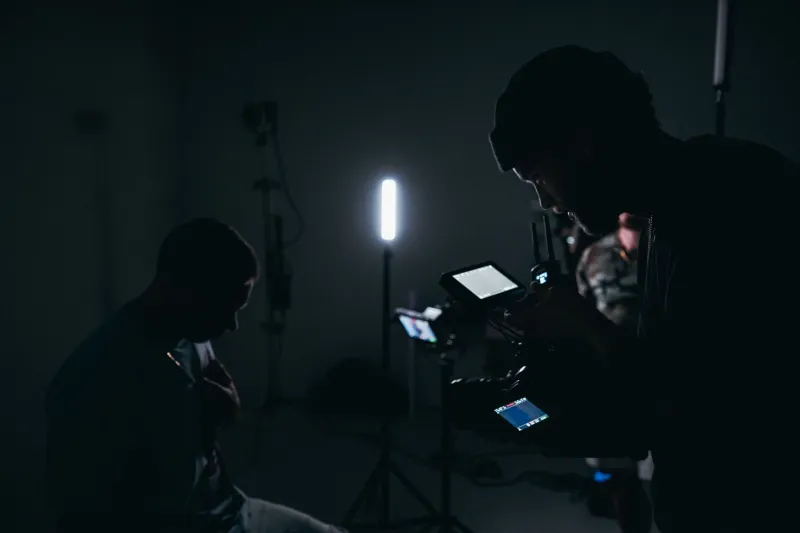
When Showing Your Work Becomes Working Against Yourself
The Camera Was Always Rolling
Somewhere along the way, we collectively decided that the process was just as important as the product. Maybe more important. Audiences started craving the rough draft, the blooper reel, the mood board pinned to the wall at 2 a.m. And honestly? For a while, it felt like a gift — finally, a way to connect with people that didn't require a finished, polished thing.
But here's what nobody really talks about: when you're always performing your process, you stop actually living inside it.
I've been thinking about this a lot lately. Not just as someone who creates, but as someone who's watched other creators slowly hollow out their work in the name of transparency. The behind-the-scenes content gets shinier. The actual output gets... quieter. Less surprising. More like something you've already seen before it was even finished.
That's not a coincidence.
The Illusion of Authenticity
Here's the trap: sharing your process feels authentic. It looks like vulnerability. It reads as relatable. And in a world where audiences are increasingly skeptical of curated perfection, showing the mess seems like the honest move.
But there's a version of that openness that's actually just a different kind of performance.
When you're documenting a brainstorm for an Instagram story while you're in the middle of the brainstorm, you've already split your attention. Part of your brain is narrating. Part of it is thinking about the caption. Part of it is wondering whether the lighting is good enough. The actual creative work — the weird, wandering, non-linear thinking that leads somewhere genuinely new — that part gets crowded out.
Creativity needs a little darkness to grow. Not mystery for its own sake, but genuine private space where ideas can be ugly and half-formed without an audience watching them stumble.
Jennifer, a textile artist based in Portland, put it plainly when I talked to her about this: "I started sharing my sketchbook online because people asked for it. And then I realized I was designing the sketchbook for the people asking. It stopped being a sketchbook. It became content."
That shift — from tool to content — is exactly where creative edge goes to die.
What You Give Away When You Share Too Soon
There's also a practical problem that doesn't get enough airtime: when you share your process in real time, you're essentially inviting external opinion into a space that hasn't solidified yet.
Ideas at the early stage are fragile. They haven't built up enough internal logic to survive criticism or even well-meaning enthusiasm. Someone comments "oh this reminds me of so-and-so" and suddenly you're either unconsciously distancing yourself from that comparison or unconsciously leaning into it. Either way, the idea is no longer fully yours.
Marco, a songwriter who's been navigating this tension for years, told me he used to share voice memos of half-finished songs with his followers. "I thought I was being open. But what I was actually doing was letting other people's reactions shape songs before I even knew what they were supposed to be. I'd finish them and they'd feel... borrowed. Like I'd already given the best parts away."
He stopped. His last album took twice as long to make and got the best reception of his career.
Strategic Transparency vs. Reflexive Sharing
None of this means you should go dark. Behind-the-scenes content, when it's intentional, is genuinely powerful. It builds trust. It humanizes the work. It gives audiences a way to feel connected to something larger than a finished product.
The difference is strategic transparency — choosing what to share, when, and why — versus reflexive sharing, which is just reaching for your phone every time something interesting happens because that's become the default.
Strategic transparency sounds like: "I'm going to share the story of how this project came together after it's done, because the full arc is more meaningful than the fragments."
Reflexive sharing sounds like: "This is a cool moment, I should post it."
One of those is a storytelling decision. The other is a habit.
And habits, especially the ones that feel productive, are the hardest to examine.
Protecting the Creative Process Without Disappearing
So what does this actually look like in practice? A few things I've seen work:
Build a delay into your sharing. Instead of documenting in real time, keep notes or photos privately and revisit them later. Ask yourself what's actually worth sharing and what served its purpose just by existing. You'll be surprised how much you're glad you kept to yourself.
Get comfortable with the finished-thing reveal. There's something genuinely exciting about an audience not knowing something is coming until it arrives. The element of surprise is underrated in an era of constant previews and soft launches.
Separate your process content from your personal creative practice. If you're going to make behind-the-scenes content, treat it like its own creative project with its own boundaries. It doesn't have to be a live feed of your actual work — it can be a curated, intentional reflection on it.
Give yourself rooms the audience doesn't have access to. Not everything needs to be a window. Some parts of your creative life are just yours, and protecting that isn't being secretive — it's being sustainable.
The Work Deserves Space to Breathe
I think the deepest issue here is that we've started to conflate visibility with value. If nobody saw the process, did the process matter? If you didn't document the struggle, did you really struggle?
Yes. Obviously yes.
The work existed before the audience did. The best parts of your creative instinct — the weird leaps, the irrational decisions that somehow work, the half-asleep idea that ends up being the whole thing — those tend to happen in the spaces between documentation, not during it.
Showing your work has its place. But so does keeping some of it close, letting it develop in the quiet, and trusting that the finished thing will speak for itself.
Not every part of the process needs a witness. Some of it just needs you.